The HVAC Knowledge Problem Is Not Just a Training Problem
In HVAC, the hard part is not only finding technicians. It is turning a few veterans' invisible judgment into repeatable field logic the rest of the team can use.
AI Summary
Argues that HVAC companies do not struggle only because skilled technicians are hard to find. They also struggle because the best diagnostic judgment often stays trapped inside a few senior people, making it hard to teach, hard to scale, and easy to lose when someone leaves.
Every human-heavy business runs into the same wall eventually: the best people know more than they can easily explain.
In HVAC, that problem gets expensive fast. A senior technician can walk into a hot attic, hear the symptom list, check a few readings, and narrow the issue down quickly. The rest of the team may see the same system and still burn twenty minutes on the wrong branch of the problem. The gap is not effort. It is transferable judgment.
The most valuable HVAC knowledge is usually the least documented
Ask a strong technician how they think through a call and you will often get a partial answer.
Not because they are hiding anything. Usually it is the opposite. They are moving too fast, and too much of their reasoning has become instinctive. They know which noises matter. Which pressure reading changes the picture. Which symptom is just noise. Which shortcut is safe, and which one creates a callback two days later.
That is why “ride with your best tech” is useful but incomplete. Observation helps. So do manuals, classes, and callbacks reviews. But none of those automatically convert expert pattern recognition into something the next technician can actually reuse under pressure.
Why this turns into a real operating risk
The U.S. Bureau of Labor Statistics says HVAC technicians typically need long-term on-the-job training, and the occupation is projected to have about 40,100 openings each year on average from 2024 to 2034. That matters because the trade does not just need more people. It needs more people who can reason through live service calls without drifting.
When the best judgment in the company lives inside three veterans, those people quietly become infrastructure. They are the escalation path. They are the quality-control layer. They are the reason certain jobs get solved cleanly and certain callbacks do not happen.
Then one person leaves, retires, or gets overloaded, and management suddenly realizes the real asset was never sitting in the training binder. It was sitting in somebody’s head.
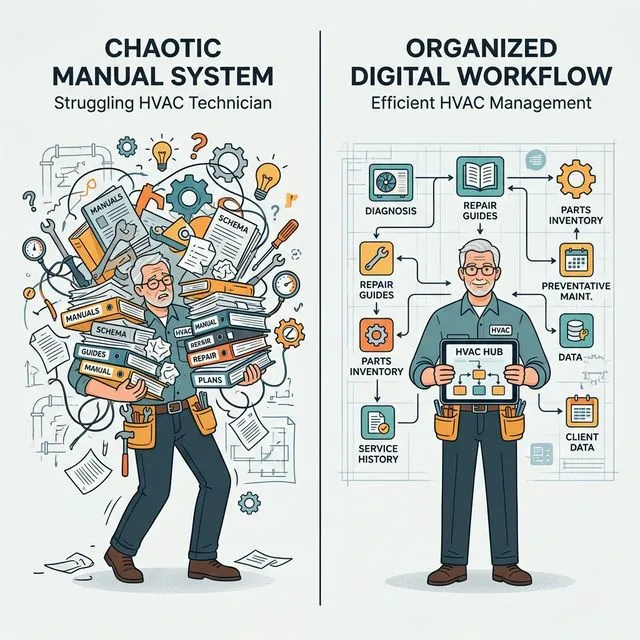
HVAC does not just need training content. It needs reusable field logic.
This is the part many shops miss.
The goal is not only to teach principles. The goal is to capture how good technicians move from symptom to test to conclusion in the real sequence of the call. What gets ruled out first. What reading matters next. What common mistake should be avoided. What should be documented before the technician leaves the site.
That is also why guided workflows matter more than generic information access. Most technicians do not need another vague answer about what a capacitor does. They need help deciding what to check next when the system is live, the customer is waiting, and the clock is running.
On the ACLogics homepage, that shows up in practical terms: guided workflows, interactive Q&A, and a structured flow from Ask to Diagnose to Fix & Report. That framing is useful because it treats knowledge transfer as an execution problem, not just a content problem.
What better knowledge transfer looks like in HVAC
Good knowledge transfer is not a giant document dump.
It looks more like turning top-performer judgment into repeatable decision paths that junior and mid-level technicians can follow without losing the reasoning behind them. It means the company can preserve more of what its best people know, make that knowledge usable during the call, and reduce how often the same senior technicians have to rescue ordinary jobs.
That does not replace experienced people. It makes their experience travel farther.
And that is the bigger point. HVAC has the same pain point as every judgment-heavy field, but the trade feels it harder because the work is technical, time-sensitive, and done in live environments. If a company wants to scale without getting brittle, it cannot rely on talent alone. It has to turn hidden expertise into reusable operating knowledge.